Thursday, June 7, 2012

Rain Delay at Blake Island

7 June 2012 Thursday

Raining early in the morning makes me make a decision before crawling out of my bunk. Too Tall agrees to stay put. With agreement made I start the coffee and have a leisurely morning. We note that it is as cold here as it is in Stockholm Sweden. I had gotten an email form a blog reader in Sweden who owns an Albin 25. So for the second day in a row the diesel heater goes on and runs most of the morning. A mug of fresh dripped coffee, a warm boat and a good friend makes nasty weather seem delightful. We find that we both think a rather funny TV program is The Big Bang Theory.

We meander up to the Village as 400 school children arrive from Seattle on an early sailing and discover that later we can buy some clam nectar on the side about 1230. I can't get enough of this Indian art and today the wood carver, Ed  is here. Too Tall is intrigued and most interested in his curved blade. I show him my knife that Too Tall gave after the Snake River trip. Ed takes it and runs the blade on the buffer to spruce it up a bit for me. Everyone is so helpful and friendly.
Entrance to Marina

Mask

Wood Carver 

Totem on Long House


After lunch the rain break is short lived and a down pour starts as we are emptying Pashmina of all the rain water. She has gotten rinsed out and I wipe off the hull. We leave her over turned on the dock for the rest of the day and night tonight, so she will be fresh to use tomorrow. Several other sailboats arrive and dock.
The sun pops out but after speaking with a Gig Harbor friend we plan to stay put for the remainder of this day.
Restoration Point off in the Distance


Clam Nectar


This book looks interesting


Cedar spilt shaft with iron wood cross pieces


Too Tall  wrestles a grizzly


Interesting Door Handles


Pashmina gets a clean bill of health

Wednesday, June 6, 2012

Lay Over at Blake Island

6 June 2012 Wednesday
Too Tall hikes the island and Hira awaits the Carylyn's departure.Later we do note that the rub rail on Pashmina's  starboard side is popped off, but easily repaired.


The Tillicum Village is not on full schedule so we lay over a day so we can experience the wonderful salmon bake and  multi visual program about the Salish Indians. The ancient voices of the past reply as we call forth all our ancestors to join the celebration.


Lt Peter Puget dresses for dinner


Lots of uses of cedar


Cedar Basket and rope

Mask and Trading Beads


Trading beads

Side Dishes of Rice and A Stew of Bison, Beef and Venison Meat


Too Tall says yum yum to the stew.
Lt Puget says I'll pass

Lt Puget Meets his first Indian on Blake

Clam nectar is drank as a toast

Lt Puget enjoys the dancers with their elaborate head dresses.


A Powerful Presence


Seattle evening lights at high tide


sunset


What a great beginning and what fun we are having.

Tuesday, June 5, 2012

Shatoosh Day 1: Skol Gets Left Behind and Pashmina Has A Rough Day

5 June2012-Tuesday

A weather front is moving in, so Too Tall decides yesterday that he is not going to take Skol. He will come on Shatoosh. Yesterday he brought numerous bags on board, more than any crew has ever brought. I'm wondering if its time to change his name to Too Many Bags. Well, they all fit in the forepeak and I have moved to the aft cabin.

Several factors need to be considered; the cold front and small craft warnings, the direction of the wind, and the extreme tides--up to a minus 4 ft. If we leave, we need to depart at the end of high tide this morning so we can ride that minus 4 ft perhaps to Blake Island. At dawn, the wind is not blowing so we decide to head out at 0630 hrs. with coffee mugs filled, empty stomachs and a burning desire to get this show on the road.

I had attached another lower line on Pashmina to hold her steady to the transom while she sits on the swim platform. If the seas were big then I was concerned about her stability. With this extra lashing I felt good that she was secured. We make good time to Eagle Island and the tide is picking up and so is the wind. At 0730hrs a beam sea washed Pashmina off the platform. I am at the helm, and feel an immediate slowing and say out loud, what was that? At first I thought we had caught something on the prop. Then I tuned and saw Pashmina in dire condition. Too Tall took the helm, headed the bow into the seas, slowed Shatoosh to nothing, then I jumped onto the aft cabin and while holding tight assessed the situation. My new line had stretched and had pinned Pashmina under the platform and she was full of water. I called for a knife, which Too Tall passed to me in no time. I cut the line and was able to get her upright but another line was preventing me from freeing her completely. I pulled her along side and switched places with Too Tall. With his long arms and legs he was able to unlash the line while hanging over the cockpit side. All this took about 45 minutes. We got her freed up and in a towable position, even though she had lots of water in her. We decided to pull into Gig Harbor and bail her out, and have breakfast. At the Tacoma Narrows we were moving at a fast 11 knots with Pashmina riding well with a belly full of salt water.


After a well deserved breakfast, another break in the rain, Pashmina get the water dumped out of her bottom. There were probably 20 gallons in her. We still had time on our ebbing tide, the rains had stopped, and Colvos Passage was as calm as a bath tub. We headed north at 1100 hrs and got into Blake at 1315 hrs.

There were sun breaks, rain squalls, all afternoon. The north wind came in about 1600 hrs along with a late afternoon arrival of the Carlyn, a 50 ft adventure boat filled with about 20 youth. Their attempts at docking created lots of problems and was not very controlled. They were blown down onto Pashmina and Shatoosh. Pashmina was side tied  and got caught briefly in a crunching situation. She survived another blow thanks to her flexible hull. The young men in charge were not making very good decisions and I had to have a few words with them to stop any further miss-haps with my boats. Upon docking the skipper came to apologize and to see if there was any damage.

Tacoma Narrows Bridges

Cut line on Pashmina


Our First Taste of Grog


The lessons learned today: Its best to stow Pashmina on the swim platform while at dock, but to tow her while under way. I am grateful for having this experience and have learned more about Pashmina the Porte-Bote. Even when loaded with water she is still towable. That is comforting to know.

Day's Run: 34nm

Sunday, June 3, 2012

Our Adventure Begins On a Very High Note

4 June 2012 Monday

Today marks the 274th birthday of King George III and 2-5 June 2012 marks the Diamond Jubilee of Queen Elizabeth 2.
How auspicious is this? There cannot be a better time to begin this adventure and not a better way to honor this historic event of Captain George Vancouver and the HMS Discovery exploring the inland waters of the Salish Sea and of Lt.Peter Puget's exploration of the southern waters, now known as Puget Sound.  As we honor these great explorers, I know that we are receiving blessing from above for the timing of these sacred events that are currently taking place. With King George III supporting us from the rears of time and Queen Elizabeth 2 leading us into the future, Shatoosh, Pashmina,  Skol 2, along with their Commanders, Hira and Too Tall Tom will have a wonderful exploration of their own.


King George III


Queen Elizabeth 2


While most of these waters are known to Hira, they are new to Too Tall. We are going to have lots of fun. Just as we honored and traveled the sacred waters of the Lewis and Clark Corps of Discovery Expedition, Too Tall and Hira will travel in the Wake of Lt. Peter Puget and have a new found reverence for these waters, as well. I hope that each of you who read this blog will learn a great deal of history and increase your own awareness of these explorations, so all our heart's will be filled with gratitude for these explorers. We will never travel these waters again without this new awareness.  Thank you Marilyn Anderson, Colonel, US Army Retired for sharing the book, Peter Puget, with me, for it has changed my whole perspective of Peter Puget and his magnificent Sound.

Monday 4 June 2012. Skol will be launched into Puget's Sound at Zittles Marina. Weather permitting, we will begin our trip north to Blake Island on 5 June and spend the evening at Blake Island. From that vantage Point and anchorage place of the HMS Discovery on 6 June 2012.

Photos by Google images

Thursday, May 31, 2012

5. Peter Puget's Exploration Party


Captain Vancouver wrote the following orders for this Expedition:

“On 20 May 1792 at 0400 hrs Lt Peter Puget, you are to disembark the HMS Discovery in the launch  and in the cutter, Mr. Whidbey, Sailing Master, whose orders you are to follow. You are to proceed  south keeping “the continental shore to starboard” at 3 days, should it appear to you that you are unable to finally determine its limits, and return to the ship by Thursday next and report to me an account of your proceedings, as to appearance of the country, its productions and inhabitants, if varying from what we have already seen. In search of the northwest passage linking the Atlantic to the Pacific.” Peter Puget's Journal: Blumenthal, Richard, editor of With Vancouver in Inland Washington Waters.

Captain Vancouver, Lt. Puget and Mr.Whidbey had sailed together in Jamaica prior to this voyage and Vancouver had hand picked this special crew: Lt. Peter Puget was 27 or 28 years old, but had been to sea since age 12 or 13, so had 24 years of naval experience under his belt. While being born in England, his ancestors were French Huguenots, who had fled during the Spanish inquisition. He was admired by his Naval superiors and highly respected by his troops. Puget achieved the rank of Rear Admiral in 1821 and died in 1822. After Lt. Puget’s exploration of the southern waters from 20-27 May 1792, Captain Vancouver named the southern waters, Puget’s Sound. 

Joseph Whidbey
Mr. Joseph Whidbey, also, near Puget’s age, was an experienced Sailing Master. [ I wondered why there were no available Journals written by Mr. Whidbey. My conversation with Richard Blumenthal, author of, With Vancouver in Inland Washington Waters, 24 Feb 2012,  states, “while Whidbey was not an Officer in the Royal Navy, he was not required to keep a journal. All the officers had to write and turn in their journals to Vancouver at the end of each exploration”]. Mr. Whidbey, while not an officer, was a member of the British Navy and retired in 1805. Captain Vancouver named Whidbey Island  for him, after he and Lt. Puget circumnavigated the island in June 1792.


Archibald Menzies, botanist and ship’s surgeon was Scottish and attended the University of  Edinburgh. He was the oldest member of the Lt. Puget’s exploration at the age of 38.
Archibald Menzies

He is noted for: 
1. Identified and named the beautifully red-barked Madrona tree for himself, arbutus menziesii, which he found on Protection Island in the Strait of Juan de Fuca. 

2. Identified and named the Douglas Fir after himself,  pseudotsuga menziesii.

3. Was the first non-native to climb the Hawaiian Volcano, Mauna Loa using the native, Ainopo Trail, which today is know as Menzies Trail.

4. To frequently concoct “spruce beer” to be drunk with the daily ration of rum. Some historians conclude this is the reason the HMS Discovery crew never suffered from Scurvy.

He often tried to learn the different languages of the Indian tribes in order  to communicate with them. He graduated from the University of Aberdeen in 1799 with a Degree in Medicine. He retired from the Royal Navy in 1802 and continued practicing medicine in England.

3rd Lt Thomas Manby, age 26, had gained much experience on board and Captain Vancouver had appointed him to 3rd Lt. He kept 2 journals, a personal one and one that he turned into Captain Vancouver.  He lived to achieve the rank of Rear Admiral, however died from an opium overdose in 1825. He loved to hunt and had a favorite double barreled gun that his good friend the Marquis Townshend had given him.

Photos from Google Images

6. The Launches


The 20 foot launch was clinker built and carried 5 pair of oarsmen, seating 2 abreast. There were 2 dismountable masts with lug sails. The other was an 18 foot cutter carrying 3 pair of oarsmen  and a single mast. Both boats were open. Both vessels had swivel guns attached.

A modern day example of  a launch with 5 paired oarsmen.
Google Images


Mr. Whidbey and Lt. Manby traveled in the cutter and Lt. Puget and Mr. Menzies went  in the launch, along with the oarsmen, which totaled 20 men. They would carry enough supplies, ammunition and food/drink, trinkets and gifts for one week. Sam McKinney, in his book, Sailing With Vancouver, stated the food was prepared in England and was made up of wheat, dried soup and spirits, vegetables, and internal oxen organs. This mixture was boiled, then dried and cut into slabs. I can see why they might like to choose eating crow, as that actually sounds better to me. Every sailor was given a ration of rum/day which was 1/2 pint. This was mixed with a quart of water to make grog and given to the sailors twice a day. Since each master ship carried 100 men that would mean there would have to be a lot of rum on board each ship. To put this into perspective a friend calculated the results: 2281 gallons /year for each ship, 9125 gallons for the 4 year expedition, 253 kegs per ship at 38 gal/keg. That, my friends, is a lot of rum. I have trouble finding room for 4 rolls of paper towels and 4 roles of toilet paper.

Preparations were underway as the HMS Discovery sailed south reaching the southern tip of  Restoration Point( named by Vancouver) on Bainbridge Island. Lat 47° 35 N, Long 122°28 W.  At about 6 PM-1800hrs the HMS Discovery anchored somewhere south of Restoration Point and near a small, rounded island, Blake Island, in 35 fathoms of water. After the HMS Discovery anchored, Lt. Puget and Mr. Whidbey quickly departed in their small boats to explore the Indian village. They returned to the HMS Discovery and prepared for their early morning departure.

Another important and interesting thing to note at this time is, the Bainbridge Island--Restoration Point Indian Village was inhabited by the Suquamish tribe of about 80 Indians  and under Chief Schweabe. His 12 year old son, Si’ahls, becomes Chief Se’alth, from which the city of Seattle, Washington is named. Later in life, he recalled seeing Captain Vancouver and the HMS Discovery. Captain Vancouver stated in his report that this Indian village was the most miserable village he had seen. 
Chief Se'alth
Google Images


Confusion has a tight grip on my beginning research. I have often wondered where this pivotal anchorage was located and I was hoping to find its latitude/longitude in the journals of the explorers, at which time I could begin my own, upcoming journey from the exact starting point.
Blake Island
 Google Images 


After reading numerous journals, books, websites and speaking with author/editor- Richard Blumenthal, With Vancouver in Inland Washington Waters, I do not know, nor does he, the exact location of their anchorage. He believes the anchorage was about half way between Restoration Point and Blake Island. In his own replication cruise of Peter Puget’s Exploration, he chose to leave from one of the Washington State Marine buoys north of Blake Island. Based on different renderings, it appears to me, that they are anchored south of Restoration Point and about 2 miles from the northern shore with the small island located off their port. Mr. Menzies clearly states they are anchored close to the inner point of it-- the round island(Blake) western tip and in 35 fathoms of water.

This position is different from what course I extracted from Peter Puget by Robert Wing and Gordon Newell where they have them anchored off Restoration Point  placing their departing course east of Blake Island or taking Blake to starboard. Some of the journals clearly state they took the island to port. Richard Blumenthal, also believes they took Blake to port. So, for me, its “Blake to Port,”  and will become  Shatoosh’s course, as it,  “keeps the continental shore to starboard,” which were Captain Vancouver’s orders. As a retired Army Officer, I do know something about the importance of following orders and giving them.

What is clear in the Journals, is the fact that, after Lt. Puget departs at 0400 hrs, the HMS Discovery was re-anchored much closer to and inland of Restoration Point at about 0800 hrs. This allowed the Discovery to be near the Indian village in order to gain access to fresh water. This re-anchoring certainly adds to the confusion for historians/interpreters of the journals but later adds confusion for Lt. Puget on 27 May 1792, when he returns from his exploration. I can hear him saying to Mr. Menzies, in the dark, early morning hours at 0200hrs on 27 May 1792, “just exactly, where is the HMS Discovery anchored?”

Wednesday, May 30, 2012

4. Immerging Coincidences Continue


At this time in my research I become aware of immerging coincidences  of my own maritime history with these explorers:

1. The coastal waters between Destruction Island and the Quillayute River of La Push, Washington--
Joyce, my crew and I were intrigued with this section of the coast and took time from our steadfast route to motor in close to Destruction Island and take photos  and to slowly meander around its outer edge, carefully avoiding the shoal on the western point. Just north of here is where the 3 Ships converge, a place where Joyce and I both thought to have magical and mystical qualities. The Quillayute Indians consider this region/islands an ancient ancestral  and sacred area. It is undoubtedly that. It is easy for me to imagine divine intervention had a hand in arranging the ship’s interception taking place. It was important for all the Captains to resolve their concerns. Just as Joyce and I had to do, before we could precede up the coast and enter the Strait. A storm held us in the port of La Push on the Quillayute River an extra day, so we could savor this exceptional corner of the world.[ blog June 2011]
Hira near Destruction Island


2. My eyes and ears perked up upon reading about the Lady Washington. I remember seeing her( a replica) for the first time. She and the Hawaiian Chieftain were docked in the small town of Rainier, Oregon in 2009. I knew I had to sail on her and that fall I crewed on the Lady Washington, Washington State’s Official Tall Ship,  taking her from Port Townsend, out the Straits of Juan de Fuca and south along the coast to her berth in Gray’s Harbor, Washington. We rounded  Cape Flattery at 0230hrs as Kyle, a young,  first mate gave me permission to take the helm. The skies were clear, the stars proliferate, and I remember feeling that I had been at the helm many times sailing a tall ship somewhere on an open ocean.

HIra at helm of the Lady Washington 2009
See posting in blog 2009.


We also, ran into the Lady Washington and her consort ship the Hawaiian Chieftain last summer in Port Ludlow, as Shatoosh was making her way south from Admiralty Inlet, also “keeping the continental shore to Starboard.” see blog posting June 2011
Port Ludlow


3. In 1986, I was part of a charter who explored the Queen Charlotte Islands on board  the 71 ft Ketch, the Darwin Sound. This was a trip that I thoroughly enjoyed as we cruised through numerous Haida Indian villages with their sacred and unique burial totems, bathed in numerous hot springs and dined well on boat that was previously owned by the famous, “Galloping Gourmet“, Graham Kerr. The well known Naturalist on board was Hilary Stewart, author of her awarding winning book, Cedar, which was icing on the cake for me.
Darwin Sound


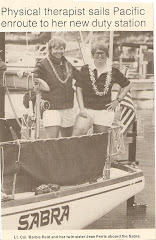
4. As a Lt. Colonel in the US Army, I had received orders to transfer from Hawaii to Washington. It was in July 1982, when I commanded my SS Sabra, a Sparkman Stephens designed, Swan 36, from Hawaii to Washington state and entered that infamous Strait of Juan de Fuca on 27 July 1982 0942 hrs. Just as the sailing instructions state, we were shrouded in a thick wall of fog stretching from Cape Flattery to Vancouver Island.  On foggy days, it is easy to understand how a ship sailing this coastline could, indeed miss the 12 nm entrance. My Loran, beeped, after 21 days at sea, informing us we were abeam and 2 nm offshore of Cape Flattery. We could barely see the bow of our boat. Yet, we confidently and steadfastly, held our course, and it took another 30 minutes of motoring to penetrate the windless, fog bank and emerge north and west of Neah Bay into bright blues skies and waters, where the majestic snow capped Olympic Mountains peaked far above the dark green forests of Douglas Fir. It was a sight to behold and is so clear in my mind’s eye today, some 30 years later. See blog Mar2012.
Fog at Strait of Juan de Fuca
Google Images

Loran Way Point at Strait.


I post this information to share how my personal maritime record, while small in comparison, does in fact, dove-tail with the northwest and transpacific travels of  Captains Cook, Vancouver, Gray and Lt. Puget. My ancestors have a greater competitive edge with  18 of my Dutch and French Huguenot- 9th great grand parents, who sailed the oceans of the world as early as 1623 to settle Dutch colonies in Nieuw  Amsterdam (Manhattan, New York),the Caribbean and South America. My Scottish ancestors rounded the horn, sailed to the Sandwich Islands, crossed the Columbia River bar and became the first coal-miners on Vancouver Island, British Columbia, the first settlers in newly formed state of Wisconsin, via the Atlantic, the Hudson, the Erie Canal and the Great Lakes and others had sailed the Atlantic, the Mediterranean, and the Arabian Sea landing in numerous ports of call in India, Mesopotamia and Egypt.


For 300 years my family lineages have been involved in Atlantic and Pacific maritime crossings: Some family names include de Forest, du Trieux, de la Montagne, Andriessen Bradt, de Hooges, Van Schoonhoven, Swartwout, Vermilyea, Van Pelt, Van Huyse, Broucard, Hendershot, Ozmun, Reid, Gilmour, Hewitt and  Dunsmuir.

Exploring and sailing is in both, my maternal and paternal blood lines and I feel that nautical bloodline course through my veins when I read about all their great adventures or step foot aboard a vessel. It is for this reason, I love to slip the dock lines from Shatoosh’s cleats and replicate the adventures of these great men and their ships. These knowingly planned and sometimes spontaneous, unknown replications are the “meat and potatoes” of my blog, which, after being birthed in 2008, has a worldwide following. I am always amazed that this has happened.